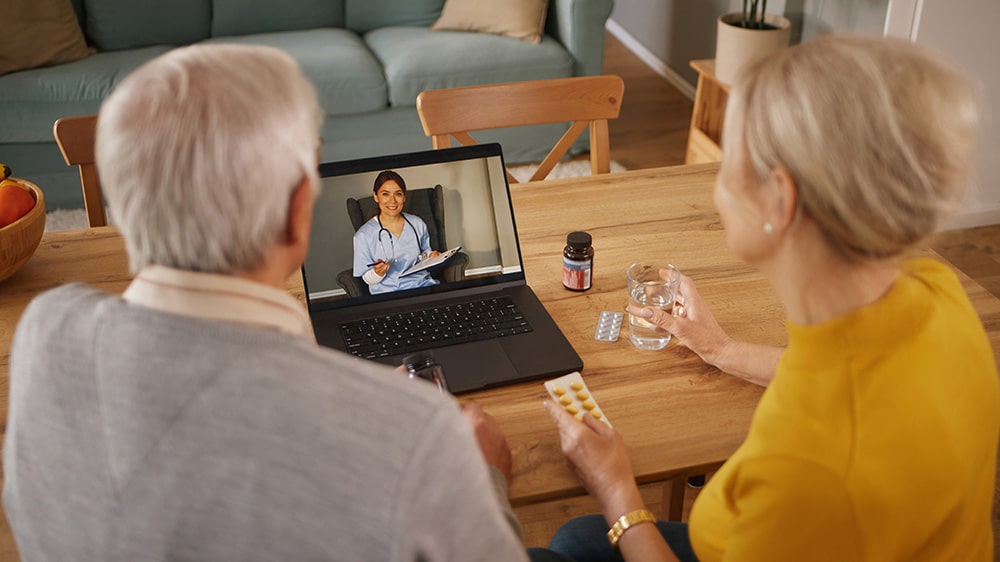
Health is not shaped by doctors’ offices alone. It’s shaped by access to care, jobs, education and community. Today, reliable high-speed internet is part of that foundation, connecting families to telehealth, education, employment and essential resources. That’s why rural access to telehealth is essential. Discover how Mercury Fiber is helping bridge the gap.
Key Takeaways:
- Internet access shapes healthcare access: a reliable connection determines whether rural patients can actually use telehealth services.
- The gap is real: about one in four Americans lack the internet or devices needed for video telehealth visits.
- Phone calls aren’t the same: audio-only visits limit what doctors can observe, especially for mental health care.
- Older adults benefit too: internet access is linked to lower rates of depression and difficulty with daily activities.
- Mercury Fiber is expanding: coverage across the Midwest is helping close this access gap for rural households.
The Crucial Role of High-Speed Internet in Healthcare
Telehealth depends on more than a patient portal and a doctor with a webcam. It depends on patients having devices, reliable high-speed internet and a stable connection capable of supporting live video visits, remote monitoring and follow-up care.
That access is not guaranteed.
Breaking the 25% Barrier
A report from the American Journal of Public Health estimates that one in four Americans does not have the high-speed internet access or devices required to participate in video-based telehealth visits, particularly in rural areas. Without reliable high-speed access, patients cannot fully benefit from modern telehealth services.
For rural households, that 25% barrier can create real consequences, such as:
- Missed or delayed medical appointments
- Long travel times to reach providers
- Limited access to specialists
- Difficulty with post-procedure follow-up
- Reduced caregiver participation
- Limited use of remote monitoring tools
Phone Visits vs. Full Video Telehealth
The American Journal of Public Health notes that when patients do not have reliable fiber internet access, they are often forced to rely on telephone calls for care. While phone appointments can still connect patients with providers, they “limit possible interactions” compared to video-based telehealth.
Audio-only calls also limit what providers can evaluate. Doctors cannot visually assess symptoms, observe body language or build the same level of personal connection. This can be especially challenging for mental health care, where face-to-face interaction often plays an important role in communication and trust.
Mobile connections are also more vulnerable to lag, buffering and dropped video calls. The difference between audio-only care and full telehealth access is significant:
| Feature | Fiber/Broadband (Video) | Telephone (Audio-Only) |
|---|---|---|
| Visual Diagnosis | Possible (skin issues, physical exams) | Impossible |
| Patient Engagement | High (seeing the provider) | Lower |
| Remote Monitoring | Yes | Limited |
| Connection Reliability | Stable | Variable |
The Benefits of Increased Internet Access
High-speed fiber helps close this gap by giving households a stronger connection for live video, multiple connected devices and consistent access to online health services. It helps people stay connected to healthcare, work, education and community support.
Rural households with reliable fiber internet can:
- Access telehealth appointments and remote care services
- Work remotely or complete online coursework
- Order groceries and essential supplies from home
- Stay connected through online communities and support groups
- Access trusted health and wellness information
- Communicate more easily with caregivers and family members
Reliable Connection Supports Healthy Aging and Independence
For older adults, reliable internet can support a larger goal: aging in place. This means being able to remain safely and comfortably at home while maintaining independence, social connection and access to care. Fiber internet can help make that possible by supporting telehealth, caregiver check-ins, prescription tools, smart home devices, remote monitoring and regular communication with family.
Research shows that internet access can meaningfully improve the quality of life for older adults. One study found it was associated with:
- 20.8% lower likelihood of depression
- 13.3% lower likelihood of difficulty with daily activities
- 5.1% lower likelihood of self-reported poor health
The same research also found that internet access promoted social participation, healthy behaviors, physical exercise and intergenerational interaction, including more frequent communication between older adults and family members. Researchers concluded that internet access can reduce social isolation and help alleviate health inequality, especially among disadvantaged groups.
For family caregivers, that point is important. A reliable fiber connection can make it easier to check in on a parent, join a video appointment, coordinate care, or help manage daily needs from a distance. Fiber internet does not replace family support or medical care. It strengthens the connection between them.
Mercury Fiber’s Rural Edge
Mercury is expanding high-speed internet access across the Midwest, helping rural communities connect to reliable healthcare and build stronger communities.
Our fiber connection helps support:
- Video calls with family and friends
- Online church, civic, or community participation
- Access to wellness classes and health education
- Online financial and benefits management
- Caregiver coordination
- Telehealth and remote care tools
- Continued connection despite distance or mobility limits
We’re proud to be serving the American heartland in Indiana, Kansas, Ohio, Michigan, and Missouri. Check to see if we serve your address today!